Taking Spin Measurements for a Spin:
Recent Progress on Black Hole Spin Measurements Across the Electromagnetic and Gravitational Spectra
September 25 & 26, 2025
Allegacy Club
LJVM Coliseum at Wake Forest University
2825 University Pkwy
Winston-Salem, NC
Spin, along with charge and mass, forms the trio of parameters that fully describe Kerr–Newman black holes in general relativity. Astrophysical black holes neutralize in very short timescales, and their mass can be estimated relatively easily with a variety of dynamical methods. However, accurately measuring black hole (BH) spin remains a significant challenge. This parameter is crucial for advancing our understanding of gravity and astrophysical processes.
Workshop Vision: This two-day workshop will bring together experts in gravitational and electromagnetic wave astrophysics to address the shared theoretical challenges of modeling and measuring black hole spins. The event will feature a mix of talks and discussions throughout the workshop. Invited speakers will present a 45-minute talk focusing on the current theoretical knowledge in their field, and emphasizing the significant uncertainties and open questions. These presentations will provide a strong foundation for integrating diverse theoretical perspectives and fostering a shared understanding of black hole spin measurements across different techniques, including X-rays, gravitational waves, and millimetric black hole imaging. Discussions will be interspersed throughout the workshop to promote collaboration and bridge gaps between these theoretical communities. Key topics will include the development of theoretical models for inferring black hole spin from astrophysical observations, as well as the exploration of observational selection effects that influence spin distributions in black hole populations, such as low and high-mass X-ray binaries (LMXBs and HMXBs) and binary black holes (BBHs). The workshop will also focus on strategies to reconcile theoretical models with observational results. The goal is to establish a unified framework for understanding black hole spin and advancing our knowledge of black hole formation and evolution through integrated theoretical approaches.
Key themes include:
– Development of self‑consistent theoretical frameworks for inferring spin from high‑resolution X‑ray spectra, gravitational‑waveforms, and horizon‑scale images.
– Quantifying observational selection effects that sculpt spin distributions in low‑ and high‑mass X‑ray binaries, supermassive black holes, and merging binaries.
– Strategies for reconciling population‑synthesis predictions with multimessenger observations and for propagating theoretical uncertainties into mission‑level science requirements.
Alignment with Current and Future Flagship Missions
NewAthena (ESA Flagship, with NASA contribution): One of the central motivations for this workshop is to build the scientific foundation needed to support NewAthena, the X-ray flagship mission concept currently under final evaluation by ESA, with direct contribution from NASA. Measuring the spins of supermassive black holes through high-resolution X-ray spectroscopy is a key pillar of NewAthena’s science objectives. By advancing theoretical techniques and improving our understanding of spin-dependent observational signatures, this workshop will produce recommendations and specific plans to support NewAthena’s science requirements, which will help prepare the community to fully exploit its capabilities in the coming decades.”
LVK Collaboration (Advanced LIGO, Advanced Virgo, KAGRA): The ground‑based network is rapidly expanding the catalogue of merging stellar‑mass black holes. Dedicated sessions will examine how waveform systematics, higher harmonics, and population inference can maximise spin information and how third‑generation detectors will sharpen constraints.
Event Horizon Telescope (EHT): Horizon‑scale imaging offers an orthogonal window on spin through polarimetric and kinematic signatures. We will explore how joint modelling of jet launching, disk dynamics, and radiative transfer can translate EHT data into robust spin constraints.
Looking Ahead—LISA & BHEX: The workshop will formulate long‑term roadmaps and coordinated simulation campaigns to ensure the community can fully exploit these missions from day one.
Deliverables and Impact: We aim to produce a white paper summarizing theoretical uncertainties, prioritizing modelling efforts, and outlining mission‑critical data‑analysis pipelines. The document will be circulated to the science community and funding agencies as input to mission definition teams and decadal‑survey panels. By unifying disparate approaches under a common framework and identifying concrete paths toward sub‑percent spin accuracy, the workshop will accelerate progress toward a comprehensive understanding of black‑hole formation, growth, and feedback across time.
Participation is limited, and attendees will have the opportunity to present a poster if they wish. This is a only in-person workshop.
The meeting is free to attend (no registration fee). Unfortunately, we are not able to provide financial assistance to speakers and participants.
Confirmed Invited Speakers
Sylvia Biscoveanu (Princeton University)
Laura Brenneman (Center for Astrophysics | Harvard & Smithsonian)
Riley Connors (Villanova University)
Paul Draghis (MIT Kavli Institute)
Daniel Palumbo (Black Hole Initiative & Center for Astrophysics | Harvard & Smithsonian)
Carl Rodriguez (The University of North Carolina at Chapel Hill)
George Wong (Institute for Advanced Study & Princeton University)
Recorded Talks:
Day 1:
Sylvia Biscoveanu (Princeton University)
George Wong (Institute for Advanced Study & Princeton University)
Riley Connors (Villanova University)
Day 2:
Paul Draghis (MIT Kavli Institute)
Daniel Palumbo (Black Hole Initiative & Center for Astrophysics | Harvard & Smithsonian)
Carl Rodriguez (The University of North Carolina at Chapel Hill)
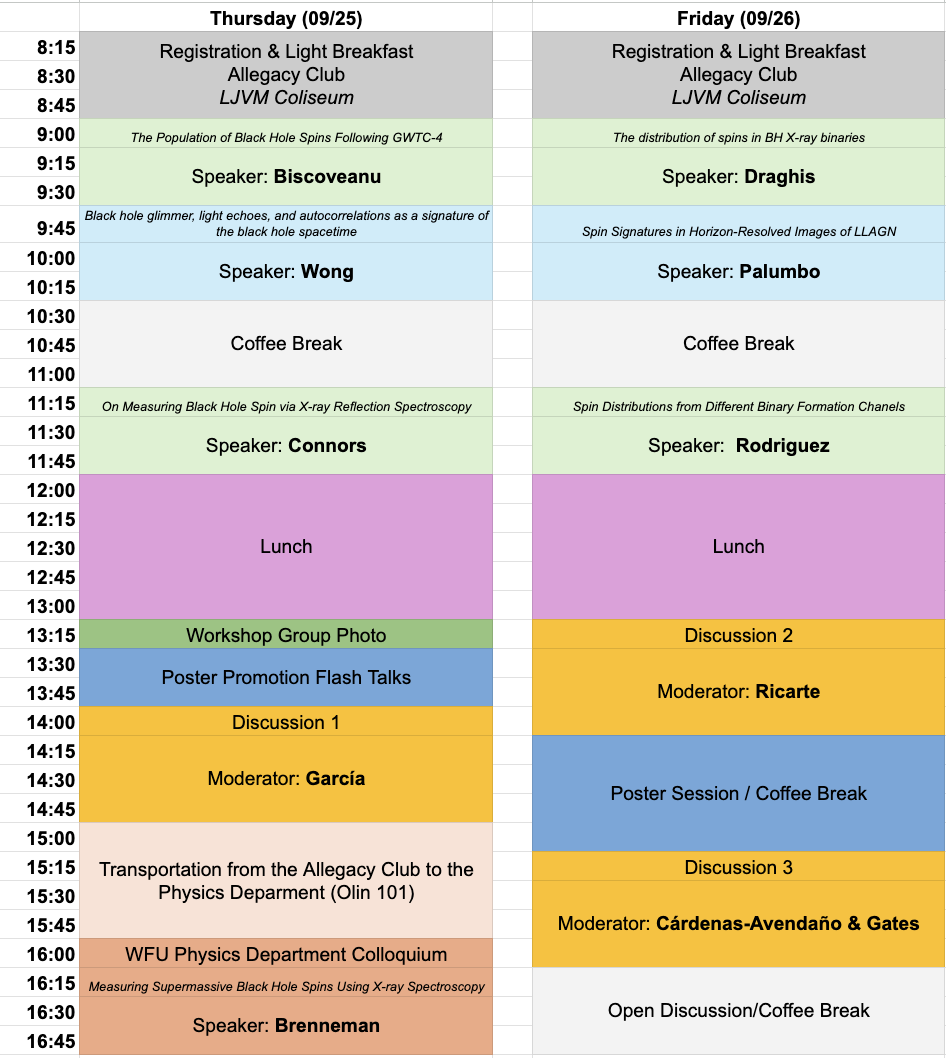
Schedule
Accepted Posters:
A. Ansari
D. Chang
J. Malewicz
C. Nagele
R. Nowicki
J. Piotrowska
L. Reali
M. Reynolds
A. Ricarte
W. Kluzniak
Important Dates
July 25: Hotel room block reservations are released.
September 8: Poster Abstract Submission Deadline.
September 12: Registration Deadline.
September 25 & 26: See you all at WFU!
Scientific Organizing Committee
Alejandro Cárdenas-Avendaño (Wake Forest University)
Delilah Gates (Center for Astrophysics | Harvard & Smithsonian & Black Hole Initiative, Harvard University)
Javier García (NASA/Goddard Space Flight Center)
Local Organizing Committee
Alejandro Cárdenas-Avendaño
Edoardo Levati
Pablo Ruales
Sydney Chandler (Physics Academic Coordinator)
Blocked Rooms
We have some rooms blocked at the Hampton Inn Winston-Salem Hanes Mall and Holiday Inn Express Clemmons for our participants (use these links to book in our group block).
These rooms are blocked until July 15th, 2025. Bookings after this date are subject to availability.
Transportation and Airports
The Piedmont Triad International (PTI) Airport (GSO) in Greensboro is the closest airport to campus—about a 30 minute drive.
Charlotte Douglas International Airport (CLT) is about a 90-minute drive to campus.
Raleigh-Durham Airport (RDU) is about a 2-hour drive to campus.
Smith Reynolds Airport in Winston-Salem provides services for private aircraft, charters and non-commercial flights.
There are shuttles to and from GSO and CLT. You can find cost and scheduling information on GSO and CLT shuttles, as well as a recommendation for private car service to RDU, on the Transportation & Parking Services website.
Black Tie Transportation (336.768.5177) in Winston-Salem provides transportation to surrounding airports (GSO, CLT, RDU).
Support
We gratefully acknowledge the support of the Physics Department & the Provost Office of Global Affairs at Wake Forest University. We would also like to thank Carrie Munson for assisting us with the logistics.